 Capolla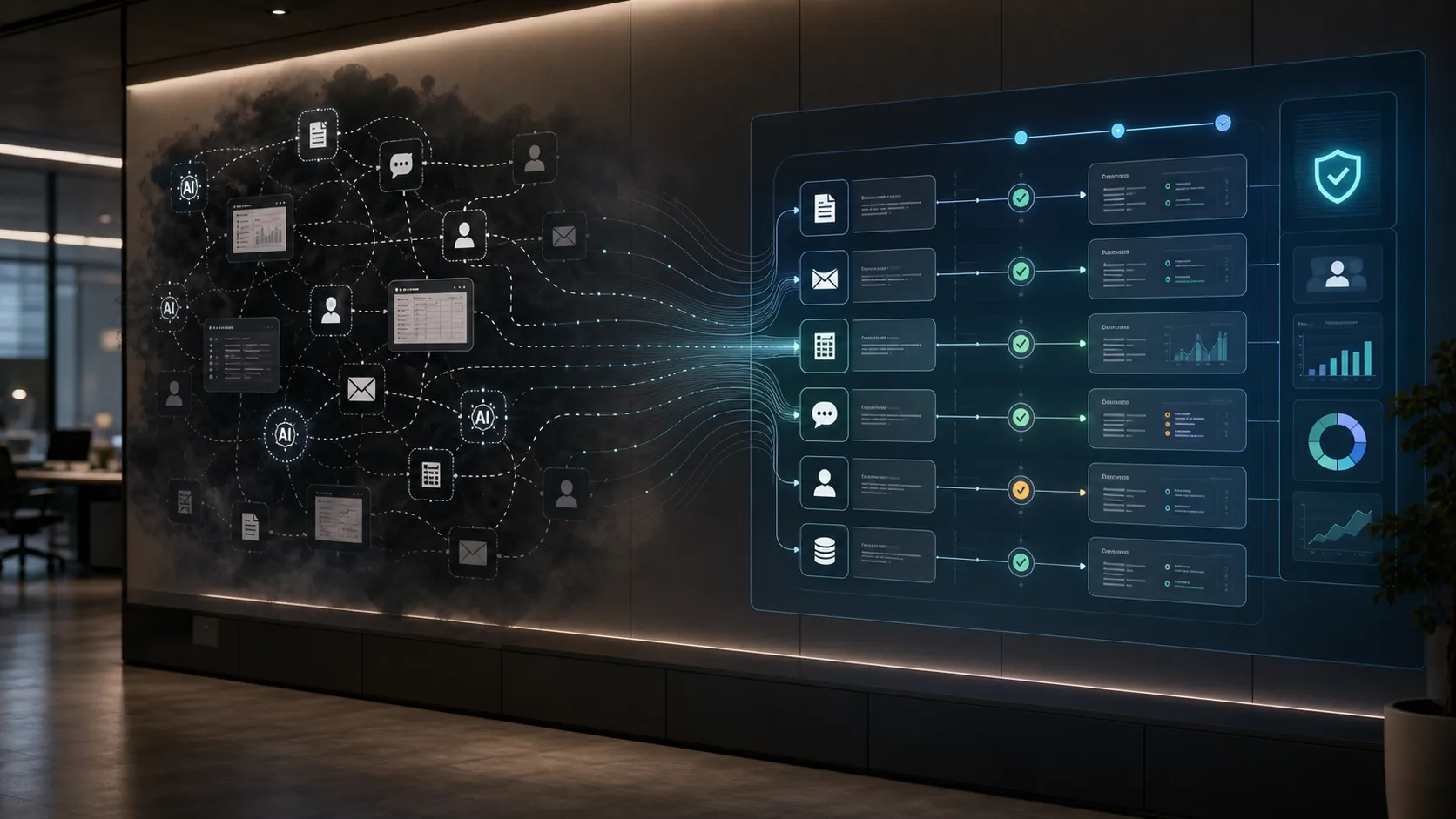
Shadow AI is becoming the new shadow IT.
The pattern is familiar. Employees find a tool that helps them move faster. The official system is too slow, too fragmented, or too hard to use. The approved workflow requires too many handoffs. The business needs the answer today. So people route around the process.
That is how shadow IT spread through cloud apps, file sharing, browser extensions, spreadsheet workflows, and team-level SaaS tools.
Now the same behavior is happening with AI.
The difference is that shadow AI is not just another unapproved app. It can summarize customer data, rewrite legal language, analyze financial spreadsheets, draft code, produce strategy documents, classify tickets, generate outbound emails, and quietly influence business decisions. It can change how work gets done without leaving a clean trail inside the official workflow.
That makes shadow AI a visibility problem before it is a policy problem.
Employees Are Already Bringing Their Own AI
The shift is not theoretical. Microsoft’s 2024 Work Trend Index found that 78% of AI users were bringing their own AI tools to work. That finding was an early signal of a broader enterprise pattern: employees were not waiting for centralized transformation programs before applying AI to daily work.
Recent shadow AI research shows the same pressure from another angle. ManageEngine’s report on the shadow AI surge in U.S. and Canadian enterprises frames the issue as unauthorized AI tools entering work because employees see immediate utility, while IT and security teams struggle to control usage patterns that keep changing.
IBM’s 2025 Cost of a Data Breach research adds the risk dimension. IBM reported that AI adoption is outpacing AI security and governance, and that shadow AI has become part of the breach and access-control discussion. Once sensitive data is copied into unmanaged tools or routed through unapproved AI workflows, the company loses visibility into where the data went, how it was used, and what decisions it influenced.
The lesson is not that employees are reckless.
The lesson is that employees are practical.
People use AI when it helps them finish work. If the approved workflow cannot match that speed, convenience, or quality, unofficial AI use will keep appearing. The more useful AI becomes, the more attractive the workaround becomes.
Shadow AI Is Different From Shadow IT
Traditional shadow IT usually meant an unapproved system.
An employee used a personal Dropbox folder. A team bought an unsanctioned project management tool. A department created a spreadsheet that became a hidden database. A manager signed up for a SaaS product before procurement reviewed it.
Those behaviors created real risk, but they were still mostly about where work lived.
Shadow AI is about how work changes.
An employee may use an unapproved AI tool to summarize a customer complaint, translate an internal document, extract themes from sales calls, debug production code, rewrite a policy, evaluate a vendor, or prepare an executive briefing. The output may then be copied back into an approved system, stripped of the evidence that AI was involved.
From the outside, the workflow looks normal.
A document appears. A ticket is updated. A slide is finished. A code review comment is posted. A customer response is sent. A spreadsheet is cleaned.
But the reasoning path is hidden. The source data may have left approved boundaries. The output may contain errors that nobody knows to check. The task may have skipped a review step because the employee trusted the model. The organization may never know that AI influenced the work.
That is the governance gap.
Shadow IT created unmanaged systems of record.
Shadow AI creates unmanaged systems of work.
Blocking Tools Does Not Fix the Workflow
The obvious response is to block unapproved AI tools.
Sometimes that is necessary. Companies handling regulated, sensitive, confidential, or customer data cannot allow unrestricted use of public AI tools. Access controls, data loss prevention, legal review, vendor assessment, and clear policy still matter.
But blocking alone does not solve the real problem.
If employees are turning to shadow AI, they are telling the company something about the workflow. The work is too slow. The approved tools are not good enough. The process creates too much manual copying. The knowledge base is too hard to search. The review queue is overloaded. The CRM has too many fields. The document template is too painful. The internal chatbot does not have the right context. The team has an urgent deliverable and no time to wait for the official path.
Shadow AI is often a symptom of operational friction.
This is where many governance programs fail. They treat unauthorized AI as a user behavior problem and respond with another policy. But the employee did not start with a policy question. They started with a work problem.
They needed to get something done.
If the company only blocks the tool without improving the workflow, employees will find another workaround. They may use a different AI service, a personal account, a browser extension, a mobile app, or a copy-paste pattern that is harder to detect.
The durable answer is not just prohibition. It is visibility, redesign, and governed alternatives that fit how work actually happens.
The Real Risk Is Invisible Decision-Making
The biggest shadow AI risk is not always the first prompt.
It is the hidden influence on downstream decisions.
A support manager asks AI to summarize complaints and changes the escalation priority. A sales rep asks AI to analyze an account and changes the renewal strategy. A finance analyst asks AI to explain variance and uses the answer in a close package. A recruiter asks AI to screen resumes and lets the summary shape who gets a call. A product manager asks AI to summarize customer research and shifts the roadmap.
In each case, AI may not be the final decision-maker. But it shaped the human’s judgment.
That influence matters.
If the company cannot see where AI entered the workflow, it cannot answer basic governance questions:
- What data was used?
- Was the data allowed to be used that way?
- Which model or tool produced the output?
- Was the output checked?
- Which human approved it?
- Did the work touch a regulated process?
- Did the AI output create rework, risk, or bias downstream?
- Was the result copied into a system of record without attribution?
These questions are hard enough for approved enterprise AI agents. They are much harder when the AI usage happens outside sanctioned systems.
That is why shadow AI belongs in the same conversation as AI control planes, agent observability, and workflow governance. The enterprise does not only need to know which AI tools are installed. It needs to know where AI is participating in work.
Shadow AI Reveals Where Work Is Broken
There is another side to this story.
Shadow AI is not only a risk signal. It is also a demand signal.
Employees use unauthorized AI where the value is obvious enough to justify the workaround. That makes shadow AI activity a useful clue for leaders. It can reveal which workflows are painful, repetitive, knowledge-heavy, under-tooled, or dependent on invisible human effort.
If employees keep using AI to summarize sales calls, the company may have a customer intelligence workflow problem. If analysts use AI to clean spreadsheets, the data pipeline may be broken. If managers use AI to draft performance feedback, the HR workflow may need better structure. If engineers use AI to explain internal code, documentation may be weak. If operations teams use AI to turn messy emails into tickets, intake may be badly designed.
The point is not to bless every workaround.
The point is to learn from the pattern.
Shadow AI shows where the official workflow is losing. That information is valuable if the company can capture it without creating a culture of fear.
Leaders should ask:
- Which tasks are employees trying to accelerate?
- Which systems are they routing around?
- Which data sources are they copying out?
- Which approvals are they bypassing?
- Which outputs are they bringing back into official tools?
- Which teams have the biggest gap between approved process and actual behavior?
- Which unofficial AI workflows should become governed workflows?
Those questions move the conversation from enforcement to operating design.
Visibility Comes Before Policy
Policies are necessary, but policies do not create visibility.
A company can write a rule saying employees should not paste sensitive data into public AI tools. That rule may be correct. It may also be ignored if the business process still depends on manual summarization, copy-paste work, undocumented judgment, and urgent turnaround.
To govern shadow AI, companies need to see the actual workflow.
That means understanding which tools employees use, how information moves between systems, where manual work happens, where review is required, where AI is already being used, and where the approved path fails to support the job.
This is the same thesis behind Capolla’s broader work: enterprise AI adoption is not just a model problem. It is a workflow visibility problem.
AI governance gets stronger when it is attached to real work patterns. Instead of writing abstract rules, the company can define specific controls by workflow:
- Which tasks can use AI freely.
- Which tasks can use AI only with approved tools.
- Which data is off limits.
- Which outputs require human review.
- Which decisions require audit evidence.
- Which workflows should be redesigned before automation.
- Which shadow workflows should become sanctioned AI workflows.
This is more practical than treating all AI use as equally risky.
Summarizing a public article is not the same as summarizing a customer contract. Drafting a generic email is not the same as drafting a regulated customer communication. Cleaning a personal task list is not the same as uploading a payroll spreadsheet. The control should match the workflow.
The Control Plane Has to See the Unofficial Work
In the last article, we argued that the AI control plane is the next enterprise software category. Shadow AI is one reason why.
The control plane cannot only manage official agents and approved apps. It also has to help companies identify where AI-shaped work is happening outside the formal architecture.
That does not mean spying on employees or treating every AI use as misconduct. It means creating an operating layer that can show patterns: where data moves, where work leaves sanctioned systems, where AI usage is likely, where approvals are missing, and where teams are building unofficial automation because the official workflow is not working.
McKinsey’s guidance on deploying agentic AI with safety and security emphasizes the need for ownership, data transparency, connected APIs, governance, monitoring, and observability for agentic systems. The same principles apply before agents are formally deployed. If employees are already using AI in the workflow, the organization still needs ownership, visibility, and auditability.
Shadow AI is what happens when AI adoption moves faster than the company’s ability to observe work.
A Better Response to Shadow AI
The better response has four parts.
First, inventory the obvious risks.
Identify which public AI tools, browser extensions, plugins, and personal accounts are being used. Understand where sensitive data could leave the company. Review vendor terms, data retention practices, access controls, and compliance requirements.
Second, map the workflows where shadow AI appears.
Do not stop at the tool name. Ask what job the employee was trying to finish. Was it summarization, drafting, coding, classification, research, analysis, translation, cleanup, routing, or decision support? Which approved workflow failed to meet the need?
Third, create governed alternatives.
Employees need approved AI paths that are good enough to use. If the sanctioned tool is slower, weaker, or disconnected from the data employees need, people will keep routing around it. Governance has to compete on usefulness, not just authority.
Fourth, attach controls to workflow risk.
Low-risk AI assistance should not be buried under the same review process as high-risk decision support. The company should define tiers: what is allowed, what requires approved tools, what requires human review, what requires audit logging, and what should not be automated.
That approach treats employees as signals, not enemies. It uses shadow AI as evidence of unmet workflow demand.
The Bottom Line
Shadow AI is spreading because AI is useful and enterprise workflows are full of friction.
Companies can respond by blocking tools and writing stricter policies. Sometimes they should. But that response is incomplete if it does not address why employees reached for unauthorized AI in the first place.
The deeper issue is visibility.
Leaders need to understand where AI is entering work, what data it touches, which decisions it influences, and which workflows are being routed around. Without that visibility, AI governance becomes reactive and incomplete.
Shadow AI is the new shadow IT, but with higher stakes.
It does not just create hidden tools. It creates hidden work.
And hidden work is exactly where enterprise AI risk and enterprise AI opportunity now live.
How visible is AI use in your organization today? “We know which AI tools our people actually use for work, including ones nobody approved” is one of twelve statements in the Capolla AI Readiness Assessment. It is also the statement organizations score themselves lowest on. Three minutes, no email required to see your result.