 Capolla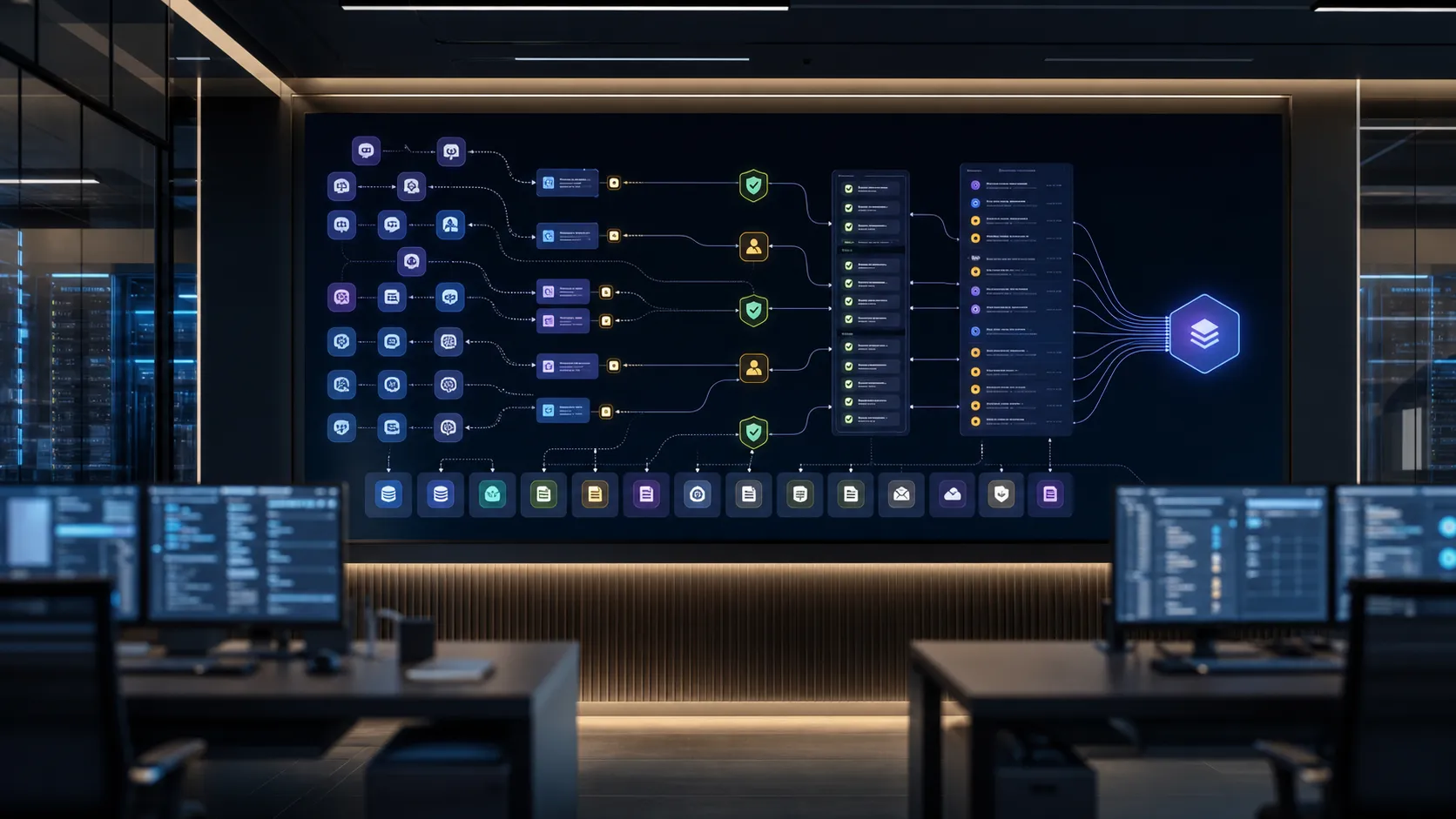
Enterprise AI is entering a new phase.
The first phase was access. Companies bought seats for ChatGPT, Claude, Copilot, Gemini, and internal assistants. Employees used them to draft, summarize, research, code, analyze, and brainstorm.
The next phase is not just better chat.
It is agents doing work inside enterprise workflows.
That shift changes the software category companies need. Once AI agents can touch business systems, call tools, read company data, generate artifacts, trigger handoffs, and make recommendations that affect real decisions, the enterprise needs more than another model interface. It needs a control plane.
That is why “AI control plane” is becoming one of the most important phrases in enterprise software. Not because every company will use the same vendor’s version of it, but because the underlying need is becoming unavoidable: organizations need a governed layer that shows what agents exist, what they can access, what they did, which workflows they touched, who approved the work, and where risk is building up.
The AI control plane is the missing management layer between AI capability and operational trust.
The Market Is Already Moving There
Microsoft has made the category explicit. Microsoft Agent 365 is positioned as a control plane for observing, securing, and governing AI agents across the enterprise, including agents built with different tools, frameworks, and models.
That matters because Microsoft is not simply selling another agent builder. It is naming the enterprise management problem: agents need identity, permissions, policy, observability, security, and lifecycle management. If agents become part of how work gets done, they need to be managed like enterprise actors, not treated like disposable chat sessions.
OpenAI is moving in the same direction from a different angle. ChatGPT Enterprise now emphasizes agents, company data connectors, admin controls, role-based access, and usage analytics. OpenAI’s own workspace analytics guide frames analytics as a way for admins to understand adoption patterns across seats, users, groups, tools, connectors, and tasks. Its apps and connectors admin documentation focuses on app usage settings, secure data flows, compliance logs, connector permissions, and data handling.
Anthropic is also pushing agents out of the generic chat window and into domain workflows. Its financial services agents package ready-to-run templates for work like pitchbooks, KYC review, and month-end close, with skills, connectors, and subagents bundled into deployable agent patterns. The important point is not just that finance agents exist. It is that they are designed around real workflow surfaces: market data, Office documents, internal systems, review conventions, and approval flows.
Then there is the adoption gap. Infosys and HFS Research recently reported that only 14% of enterprises have reached the scaling stage with agentic AI, while most remain in early phases. The same report highlights fragmented ownership, data readiness issues, governance constraints, limited real-time data availability, and discomfort granting agents broad access to sensitive enterprise data.
Put those signals together and the market direction is clear.
The agent layer is getting more capable. The governance layer is still immature.
That gap is the software category.
Why Agents Break the Old Admin Model
Traditional enterprise software administration assumes users are people.
A human logs in. A human receives a role. A human clicks a button, exports a file, changes a record, sends a message, or requests approval. The audit trail may be imperfect, but accountability is still organized around a person.
AI agents blur that model.
An agent may be initiated by a person but then execute multiple steps. It may retrieve data from one system, summarize it, reason over it, call another tool, draft a document, update a record, notify a team, and recommend a decision. Some agents will run on demand. Others will run on schedules. Others will monitor events and act when conditions change.
That creates questions most existing admin consoles were not designed to answer:
- Which agents are active in the company?
- Who owns each agent?
- Which systems can each agent access?
- What data did the agent read?
- What tools did it call?
- What decision rules or prompts shaped its behavior?
- Which actions were automatic and which required approval?
- Where did the output go?
- What happened when the agent was uncertain?
- Who is accountable if the agent creates operational, legal, financial, or customer risk?
Without answers, enterprise AI agent governance becomes theater. The company may have a policy document, but it does not have operational control.
This is the same reason shadow AI is becoming a serious management problem. Employees already route work through unsanctioned tools when official systems are slower or less useful. Agents amplify that behavior. A shadow AI assistant is one thing. A shadow automation that can touch live business data, generate deliverables, and trigger downstream work is a different risk class.
The control plane exists because the old admin model cannot see enough.
Observability Becomes a Business Requirement
Agent observability is often discussed as an engineering problem: traces, logs, tool calls, latency, errors, model outputs, retrieval steps, and evaluations.
That layer matters. But enterprise agent observability has to go further.
Business leaders need to understand how agents affect workflows. Did the agent reduce review time? Did it increase exception volume? Did it change who approves work? Did it create more rework downstream? Did employees trust the output, or did they copy it into a side document and quietly redo it? Did it reduce bottlenecks, or did it simply move the bottleneck to a manager’s inbox?
Those are not model metrics. They are workflow metrics.
This is where the AI control plane must connect to the reality of work. It cannot only show that an agent called a tool successfully. It must show whether the agent’s work moved through the business process correctly.
For example, a finance agent that helps close the books is not successful just because it generated a reconciliation note. It is successful if the note used approved data sources, flagged exceptions correctly, preserved audit evidence, routed material variances for review, and reduced the time between investigation and sign-off.
A customer support agent is not successful just because it drafted a response. It is successful if it respected escalation policy, used the latest account context, avoided unsupported promises, captured the reason code, and improved resolution without increasing compliance risk.
The enterprise does not need “agents everywhere.” It needs visible, governed participation in specific workflows.
The Control Plane Is Really a Workflow Layer
The phrase “AI control plane” can sound technical, but the deeper issue is operational.
Enterprises do not just need to control agents. They need to control the work agents participate in.
That distinction matters. If a company only governs agents at the tool level, it may know that an agent has access to SharePoint, Salesforce, Jira, Workday, or a data warehouse. But it still may not know whether the agent is being used inside a compliant process.
The same tool access can be safe in one workflow and dangerous in another.
Reading a contract to summarize renewal terms may be low risk. Reading the same contract to recommend legal concessions may require review. Drafting a customer email may be fine. Sending it without approval may not be. Summarizing a market report may be harmless. Combining that report with non-public financial data may create disclosure risk.
Governance has to attach to the workflow, not just the model.
That is why the next enterprise software category will likely combine several functions that used to live apart:
- Agent registry and ownership.
- Identity, permissions, and least-privilege access.
- Tool and connector governance.
- Approval routing and human review.
- Audit trails and compliance exports.
- Workflow mapping and process discovery.
- Runtime monitoring and exception handling.
- Usage analytics and adoption visibility.
- Policy enforcement across teams, tools, and data sources.
Some of this will come from large platforms. Microsoft, OpenAI, Anthropic, ServiceNow, Salesforce, Google, and others will all offer pieces of the stack. But enterprises will still have a hard problem: work does not live cleanly inside one vendor boundary.
Real workflows cross email, spreadsheets, documents, CRMs, ERPs, support tools, chat, file drives, BI dashboards, custom systems, and informal approvals. That messy operating layer is exactly where AI agents are being asked to help.
The control plane has to see across that mess.
Capolla’s Thesis: Visibility Comes Before Automation
At Capolla, our view is simple: before companies can automate work with AI, they need to understand how the work actually happens.
The official process is rarely the full process. Employees use side channels, judgment calls, spreadsheet workarounds, manual checks, and informal approvals to keep the business moving. Those hidden patterns are often invisible to leadership, but they are exactly the patterns that determine whether AI workflow automation succeeds or fails.
An AI agent cannot safely participate in a workflow the organization itself cannot see.
That is why workflow visibility belongs in the AI control plane conversation. If the control plane only manages models and permissions, it will miss the operating context. If it also observes how work moves across systems, screens, handoffs, and approvals, it can help teams decide where agents should act, where humans should review, and where the process needs redesign before automation.
This is especially important for shadow AI. The answer is not just to block tools. Blocking may be necessary in some cases, but it does not explain why employees reached for those tools in the first place. Usually, people create shadow workflows because the official workflow is too slow, too fragmented, or too disconnected from how the work really gets done.
The control plane should expose that gap.
What Buyers Should Look For
As this category forms, buyers should be careful not to treat every agent dashboard as a control plane.
A real AI control plane should help answer four questions.
First: what agents exist, and who owns them?
There needs to be a registry of agents, purposes, owners, business sponsors, connected systems, data access, and lifecycle status. If the company cannot inventory agents, it cannot govern them.
Second: what can each agent do?
Permissions should be specific to the task, workflow, data source, and action type. Read access is different from write access. Drafting is different from sending. Recommending is different from approving. Querying internal knowledge is different from touching regulated customer or financial data.
Third: what did the agent actually do?
The system needs durable audit trails: prompts or instructions where appropriate, retrieved sources, tool calls, approvals, outputs, downstream destinations, exceptions, and user overrides. This is where agent observability becomes useful to risk, compliance, operations, and business teams, not only engineers.
Fourth: did the workflow improve?
The control plane should connect agent activity to operational outcomes: cycle time, rework, queue volume, exception rate, approval latency, escalation quality, and adoption by team or business unit. Otherwise companies will measure usage and call it transformation.
Usage is not the same as value.
The Category Will Be Bigger Than Governance
The AI control plane will start as a governance and security need, but it will not stop there.
Once companies can see agent activity and workflow impact, the same layer becomes useful for automation planning, process redesign, vendor consolidation, compliance reporting, operating model design, and AI investment decisions.
That is what makes this category strategically important. It is not just a safer way to deploy agents. It is a way to understand where AI belongs in the enterprise operating system.
The winners in this market will not simply provide more buttons for admins. They will help companies answer a more difficult question:
Where can agents create leverage without breaking trust?
That requires model awareness, connector governance, identity controls, observability, approvals, auditability, and workflow visibility. It also requires a sober understanding that AI adoption is not just a technology rollout. It is an operating model change.
The Bottom Line
AI agents are moving from chat windows into enterprise workflows.
That movement creates a new management problem. Companies need to know what agents are doing, what they can access, which workflows they affect, where humans remain accountable, and whether the work is actually improving.
Microsoft Agent 365, OpenAI’s enterprise admin and analytics tooling, Anthropic’s domain-specific finance agents, and the Infosys/HFS adoption data all point to the same conclusion: the market is moving from AI experimentation toward governed execution.
The next enterprise software category is the AI control plane.
The companies that get it right will not be the ones that deploy the most agents. They will be the ones that can see, govern, and improve the workflows those agents touch.